Universities of Wisconsin Expand AI Use as Students Rethink the Four-Year Degree

Universities are no longer debating whether students will use AI — they’re deciding how to integrate it at scale. In Wisconsin, the Universities of Wisconsin system says it plans to expand AI use across its 13 universities, emphasizing “AI literacy” alongside “durable skills” that help graduates move from job to job.
That’s a sensible direction. But it also raises a bigger question: if AI turns knowledge work into a faster, more tool-driven process, will the classic four-year degree remain the default path — or will we see a future of smaller, modular learning models that look more like “micro-universities” than traditional campuses?
Wisconsin’s Move Signals the New Baseline: AI Literacy
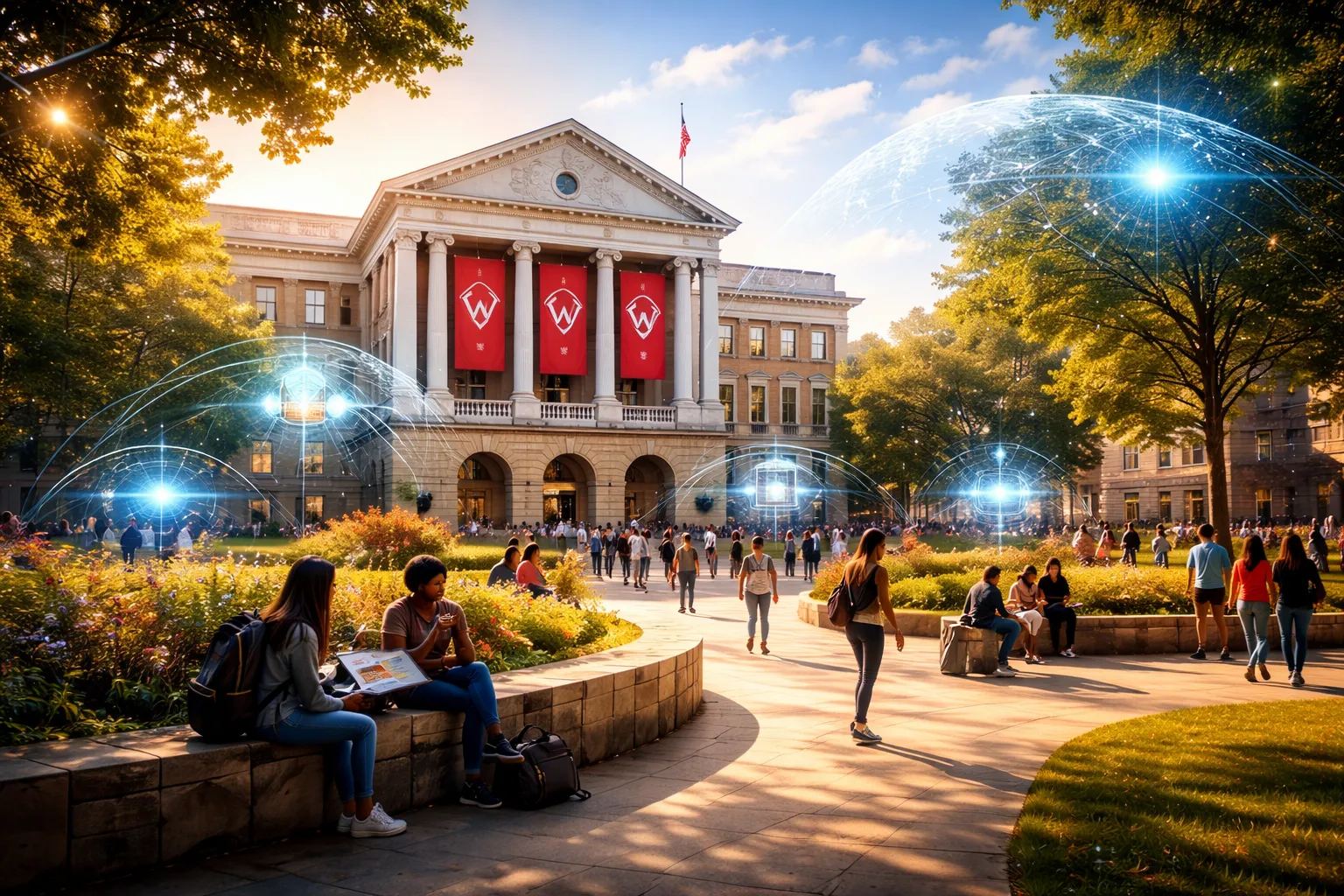
Treating AI as a standard tool — not a forbidden shortcut — is becoming the practical default. The best comparison isn’t “cheating,” it’s literacy. Students will enter workplaces where AI tools are embedded in communication, analysis, documentation, and software workflows. Higher education can either pretend this isn’t happening, or teach students how to use AI responsibly and verify outcomes.
This shift also matches what major labor and education systems are signaling globally: the winning strategy is not banning tools, but building strong judgment around them — critical thinking, source-checking, and knowing when AI is confidently wrong.
Degrees Still Matter — but the “Unit of Education” Is Changing
The four-year degree is not “dead.” In many fields, it remains the strongest signal for baseline training and long-term earning potential. But institutions are facing pressure on another axis: speed. AI is compressing cycles of learning, production, and experimentation. In that environment, the question becomes less “Should people learn?” and more “How fast can education adapt to real workflows?”
This is why micro-credentials are gaining legitimacy. Europe’s formal “micro-credentials” framework explicitly treats shorter learning units as recognized, stackable proof of skills for employability and lifelong learning — not as random certificates, but as structured education artifacts that can complement traditional degrees.
Meanwhile, the World Economic Forum’s job-skills research points to rapid change in employer demand, including growth in analytical thinking, creative thinking, and AI/data-related capabilities. Whether students learn those skills in four-year programs, two-year programs, or modular tracks, the direction is consistent: the market rewards skill velocity.
The Next Generation May Choose Micro-Universities Over “One Big Degree”

Here’s our bet: the future “default” path for young people may shift from being primarily young workers climbing ladders to being young micro-entrepreneurs building small, AI-augmented income streams — often while learning. Not everyone will become a founder, but the baseline expectation of “one employer, one track, one long ladder” is weakening.
The evidence isn’t just cultural — it’s structural. New business formation remains elevated compared to pre-2020 levels, based on U.S. Census Bureau Business Formation Statistics releases. Pair that with AI tools that dramatically reduce startup friction (marketing, drafting, design, automation, customer support), and you get a plausible near-term outcome: more people trying small ventures earlier, with fewer gatekeepers.
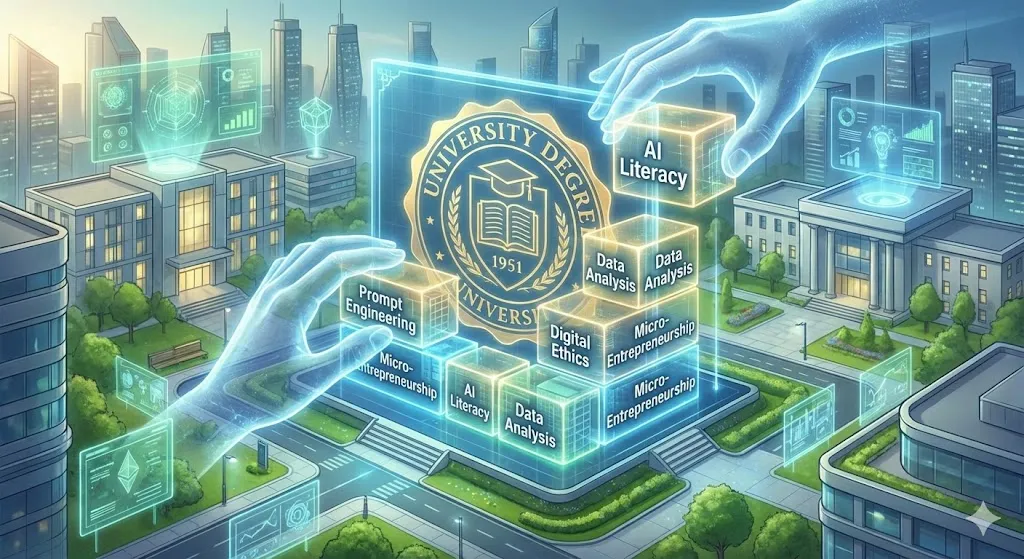
In that world, micro-universities make sense: smaller, focused programs designed around “skills-to-output” loops. Think: a 6–10 week cohort that teaches a specific workflow (data analysis + reporting, AI-assisted content ops, automation, prompt engineering, UI prototyping), and ends with a portfolio artifact or a working micro-product. These programs wouldn’t replace research universities — but they could become the on-ramp for modern careers, especially as traditional degrees become harder to justify on time and cost alone.
The best universities will adapt by becoming “platforms,” not just classrooms: teaching AI fluency, verification, ethics, and domain mastery — while also offering stackable learning, apprenticeships, and pathways into real outputs. Wisconsin’s direction is a step toward that future: AI as a tool, accountability as the standard.
Try It Yourself: Prompts for Studying and Building
If you’re a student (or building a side project), prompts can be a real advantage — not for replacing learning, but for speeding up practice, feedback, and iteration.
On VibePostAI you can find prompts for studying, research summaries, portfolio projects, micro-apps, and career workflows — and save your own collections. Join VibePostAI →
Sources
U.S. Census Bureau — Business Formation Statistics (Press Release, Dec 12, 2025)
World Economic Forum — The Future of Jobs Report 2023
Bruegel — Does skills-first hiring work? (Policy brief on skills vs degree signals)
Generated for the VibePostAI editorial feed. Explore prompts, mixes, and creator tools:
VibePostAI /signup