AI Helps Astronomers Discover Hundreds of Hidden Cosmic Anomalies in Hubble Data

Archive
Artificial intelligence is rapidly changing how scientists explore the universe, not by replacing human insight, but by dramatically expanding what researchers are able to see. A new study using AI-assisted analysis of the Hubble Space Telescope’s vast image archive has uncovered nearly 1,400 rare and unusual cosmic objects — more than 800 of which had never been documented before.
The Real Limit Was Never Curiosity — It Was Scale
The work highlights a growing reality across science: modern discovery is increasingly limited not by imagination or expertise, but by scale. Decades of astronomical observations exist, but much of that data has remained effectively untouched because of the sheer volume involved.
That constraint is now beginning to shift.
AnomalyMatch: Compressing Lifetimes of Search Into Days
Researchers David O’Ryan and Pablo Gómez of the European Space Agency developed a neural network called AnomalyMatch to help identify rare astrophysical objects hidden inside the Hubble Legacy Archive. The archive spans more than 35 years of observations and contains tens of thousands of datasets, far beyond what could realistically be reviewed manually at the level required to find unusual phenomena.
Using their AI system, the team processed nearly 100 million image cutouts in just two and a half days. What would have taken human researchers many lifetimes was compressed into a single computational pass, allowing scientists to focus their attention on interpreting results rather than searching blindly.
“Archival observations from the Hubble Space Telescope now stretch back 35 years, providing a treasure trove of data in which astrophysical anomalies might be found,” O’Ryan said. “But the scale of that archive makes systematic human inspection impractical.”
What They Found: Lenses, Collisions, Rings — and the Unclassifiable
Source
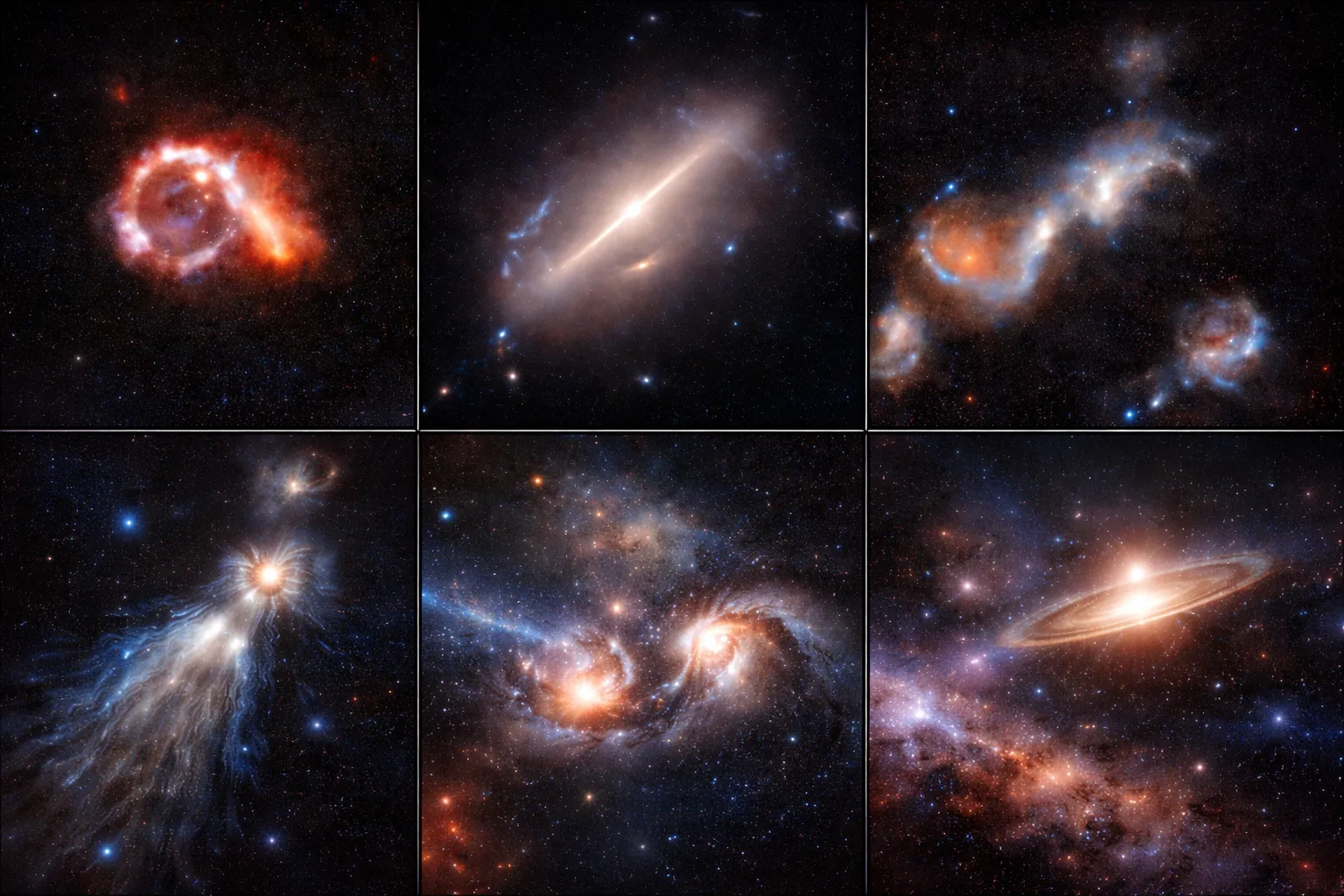
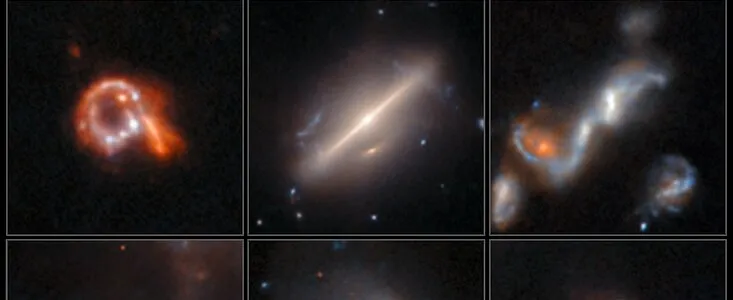
After the AI completed its search, O’Ryan and Gómez manually reviewed the most promising candidates. The results were striking. More than 1,300 objects were confirmed as genuine anomalies, including colliding and merging galaxies with distorted structures, gravitational lenses that bend spacetime and warp distant light, ring galaxies, and jellyfish galaxies trailing streams of gas and stars.
The team also identified planet-forming disks viewed edge-on, giving them unusual shapes, along with several dozen objects that defied existing classification altogether.

While trained astronomers are highly skilled at spotting unusual features, the reality is that modern telescopes generate far more data than experts can inspect in detail. Citizen science projects have helped distribute some of that work, but even large volunteer efforts struggle to keep up with archives on the scale of Hubble’s.
AI changes that equation by acting as a discovery multiplier.
“This is a fantastic use of AI to maximise the scientific output of the Hubble archive,” Gómez said. “Finding so many anomalous objects in data where you might expect most of them to have already been discovered shows how powerful this approach can be.”
Why This Matters Now: The Next Data Flood Is Bigger Than Hubble
The timing is significant. Hubble is only one of many data-rich observatories now operating or coming online. ESA’s Euclid mission has begun surveying billions of galaxies across a large portion of the sky. The Vera C. Rubin Observatory is preparing to launch a ten-year survey that will generate more than 50 petabytes of images. NASA’s Nancy Grace Roman Space Telescope is scheduled to launch by 2027, adding yet another massive stream of observations.
In this context, AI is no longer a convenience — it is becoming infrastructure.
Rather than replacing scientists, systems like AnomalyMatch help redefine where human expertise is most valuable. The AI narrows the search space, while researchers apply judgment, theory, and creativity to understand what those findings mean. Discovery becomes less about chance and more about systematic exploration.
The broader implication extends well beyond astronomy. As datasets grow across fields ranging from medicine to climate science, AI is increasingly being used not to automate conclusions, but to surface signals that would otherwise remain buried.
In the case of Hubble’s archive, the universe itself has not changed — but our ability to notice what has been there all along has.
Perhaps most intriguingly, among the newly identified anomalies are objects that resist current scientific categories altogether. They serve as reminders that even in well-studied data, there are still phenomena waiting to be understood.
AI did not invent these discoveries. It simply made them visible.
Sources
ESA/Hubble — “Researchers discover hundreds of cosmic anomalies with help from AI” (Jan 27, 2026)
ESA/Hubble — Hubble mission context, archive notes, and image credits
European Space Agency — Science & Exploration (Euclid and future missions context)
More science + AI coverage, prompt mixes, and creator tools:
Join VibePostAI