
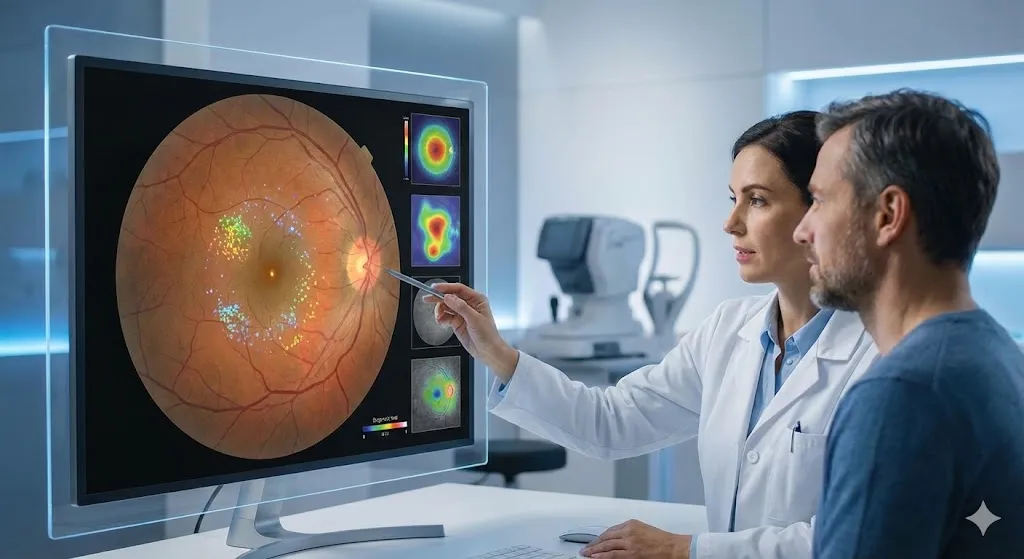
AI Is Becoming a Clinical Partner in Eye Care, Not Just a Diagnostic Tool

Artificial intelligence is no longer an experimental add-on in ophthalmology. At the 2nd International Glaucoma Symposium (IGS 2026) in Mainz, Germany, AI emerged as a practical, integrated component of everyday clinical care — particularly in retinal imaging, screening, and workflow optimization.
Where AI Is Delivering Real-World Impact Today
Speaking at the symposium, Priv.-Doz. Dr. med. Jan H. Terheyden, FEBO, an ophthalmologist at the University of Bonn, described how AI systems are already supporting clinicians by addressing clear bottlenecks in eye care delivery. Rather than replacing ophthalmologists, these tools are increasingly designed to extend clinical capacity in areas where demand outpaces human review.
According to Terheyden, the strongest clinical impact is currently seen in retinal imaging, especially for conditions such as diabetic retinopathy and other retinal diseases. These applications succeed because they rely on large, standardized image datasets and target well-defined screening and triage challenges.
In many cases, AI algorithms now approach — and in some contexts match — expert-level performance. Crucially, they can be deployed at scale, enabling earlier detection and more efficient prioritization of patients who need specialist care.
Beyond diagnostics, workflow-focused AI tools are also gaining traction. Ambient clinical scribes, automated documentation systems, and image-quality assessment tools are reducing administrative overhead. For ophthalmologists, this means less time spent on clerical tasks and more time focused on patient interaction and complex clinical decision-making.
The Challenge Is Integration, Not Accuracy

Despite impressive algorithmic performance, Terheyden emphasized that adoption challenges remain. The primary hurdle is not whether AI can perform well in controlled environments, but whether it can be integrated seamlessly into real clinical workflows.

Issues such as generalisability, explainability, and clinician trust remain central. Models trained on curated datasets may not always reflect the diversity and variability of real-world patients and imaging conditions. If AI systems introduce additional cognitive burden or workflow friction, their clinical value diminishes — regardless of technical accuracy.
As a result, the next phase of AI adoption in ophthalmology depends less on marginal performance gains and more on usability, transparency, and contextual reliability.
Moving Beyond Standalone Diagnostics
Looking ahead, Terheyden highlighted a shift away from isolated diagnostic tools toward clinically integrated, multimodal AI systems. These systems combine imaging with longitudinal clinical data, functional assessments, and patient history to support earlier detection and better disease progression monitoring.
This approach is especially promising in areas such as glaucoma, where subtle changes over time are often more informative than single measurements. By automating repetitive tasks like segmentation, risk stratification, and quality control, AI allows clinicians to focus on higher-level judgment rather than raw data processing.
What the Next Decade of Ophthalmic AI May Look Like
Over the next five to ten years, the most significant advances are expected to come from foundation models, real-world validation studies, and regulatory frameworks capable of keeping pace with rapid AI development. Rather than proving isolated concepts, future systems will need to demonstrate sustained clinical value across diverse populations and practice settings.
If successful, this evolution could help move AI in ophthalmology from selective deployment to routine, equitable care — not as an autonomous decision-maker, but as a trusted clinical partner.
Sources
More AI coverage, tools, and prompt culture from the VibePostAI feed:
Join VibePostAI