
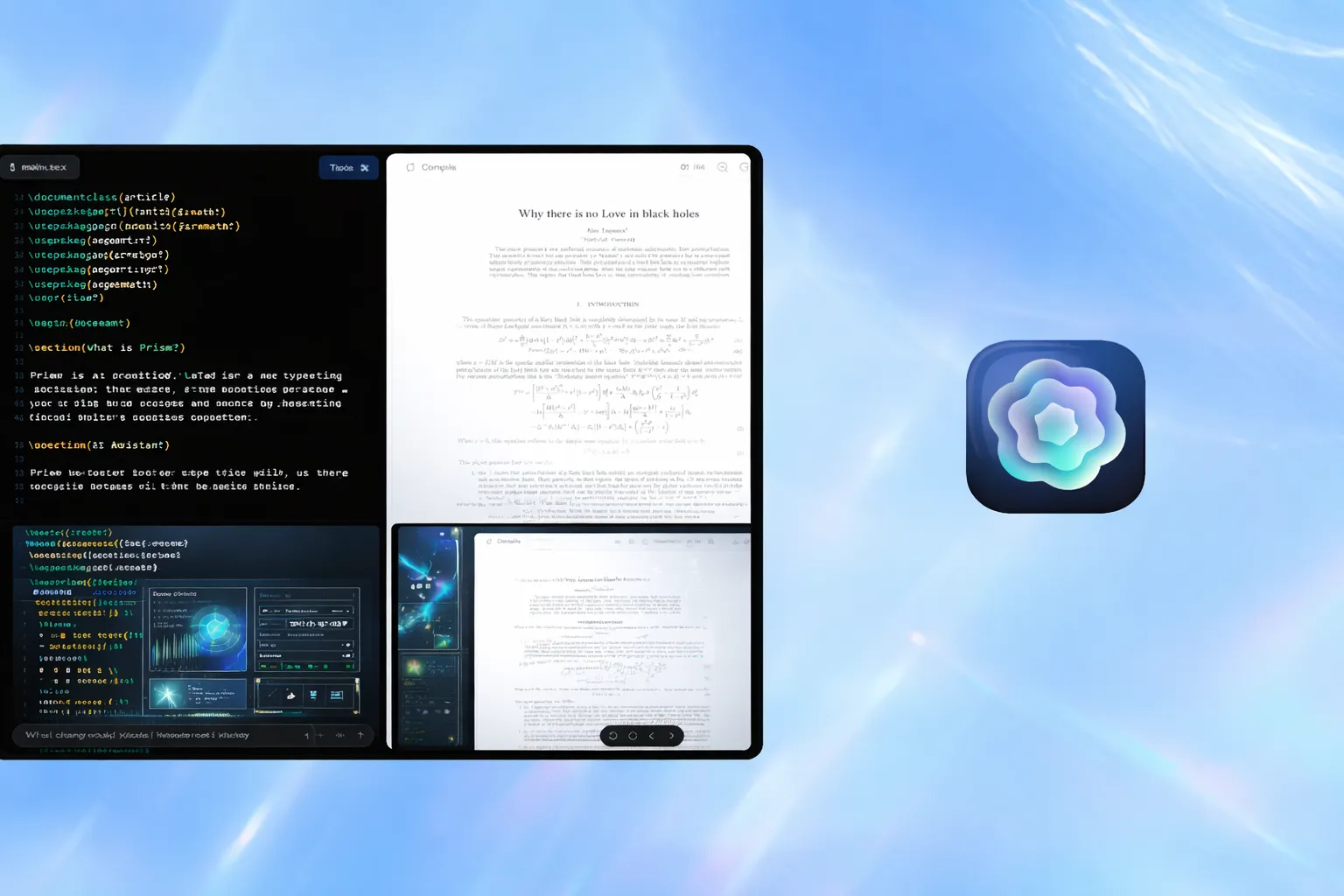
OpenAI Prism Signals the Shift Toward AI-Native Research Tools

OpenAI has launched Prism, a new AI-native workspace designed specifically for scientists, researchers, and academic teams. Rather than positioning Prism as another general-purpose chatbot, OpenAI is framing it as a dedicated environment for scientific writing, collaboration, and reasoning — signaling a broader shift toward domain-specific AI platforms.
What Prism Is — And What It Is Not
Prism is an AI-native workspace built around scientific workflows rather than casual prompting. It supports long-form technical writing, structured reasoning, collaborative editing, and citation-aware assistance in formats commonly used by researchers, including LaTeX-based documents.
Unlike traditional document editors that bolt AI on as a feature, Prism is designed from the ground up with AI as a core collaborator. Users can draft papers, revise sections, reason through experimental design, and iterate on complex arguments inside a single environment — without constantly switching tools.
Importantly, OpenAI has emphasized that Prism is not intended to replace scientific judgment. The system assists with structure, clarity, synthesis, and exploration, but the responsibility for claims, interpretation, and conclusions remains firmly with the human researcher.
Why OpenAI Is Building Vertical Tools

Prism reflects a strategic shift that has been quietly unfolding across the AI industry: moving away from one-size-fits-all assistants toward vertical, workflow-native systems. Rather than asking users to adapt their work to AI, these tools adapt AI to how work is already done.
Scientific research is a natural candidate for this approach. Research workflows are document-heavy, iterative, and collaborative. They involve long feedback loops, careful citation practices, and complex reasoning — all areas where generic chat interfaces begin to show their limits.
By creating a dedicated workspace, OpenAI is signaling that the future of AI adoption may not be about replacing existing software, but about rebuilding key tools with AI embedded at the structural level.
What This Means for Researchers and Institutions

For individual researchers, Prism lowers friction. Tasks that once required juggling multiple tools — drafting, revising, summarizing literature, coordinating collaborators — can now happen in a single environment. That can significantly reduce overhead, especially for small teams or independent researchers.
For institutions, Prism raises more complex questions. AI-assisted research environments blur traditional boundaries around authorship, attribution, and academic integrity. While Prism does not automate discovery, it does accelerate production — and that may force universities, journals, and funding bodies to rethink evaluation standards.
OpenAI has stated that Prism is free for individual users with a ChatGPT account, with enterprise and education offerings expected later. That positioning suggests an attempt to normalize AI-native research tools before institutional procurement frameworks fully catch up.
The Broader Signal: AI as Infrastructure, Not Assistant
Prism fits a broader pattern we’ve tracked at VibePostAI: AI is increasingly becoming infrastructure rather than a novelty feature. Similar moves are appearing in software development, design, analytics, and education — where AI is embedded into the workflow itself instead of sitting on the side.
This mirrors how elite engineers and builders already work with AI today. The most effective users are not outsourcing thinking, but reallocating effort — letting AI handle structure and repetition while humans focus on judgment, intent, and direction.
Prism does not mark the end of scientific authorship. It marks the normalization of AI as a collaborator — one that shapes drafts, explores alternatives, and accelerates iteration without replacing accountability.
A Preview of AI’s Next Phase
OpenAI Prism is less about scientific disruption and more about maturation. It shows how AI tools evolve once early experimentation gives way to real-world workflows. The focus shifts from “what can AI do?” to “where does AI belong?”
If Prism succeeds, it may serve as a template for future AI-native platforms — not just for science, but for any field where thinking, writing, and collaboration intersect at scale.
Sources
TechCrunch — OpenAI launches Prism, a new AI workspace for scientists
Times of India — OpenAI launches Prism for scientific collaboration
More AI platform analysis, prompts, and editorial insights:
Join VibePostAI